A full-service hotel can be packed with guests and still schedule labor poorly. Employees may be overloaded during breakfast, underused during the afternoon, and pushed into overtime because the staffing plan never followed the actual demand curve.
Advanced Labor Productivity Models approach the problem differently. They connect employee hours with rooms, restaurant covers, events, arrivals, service requests, and other measurable workload.
Hotels can then deploy people when and where they create the most value. The objective is not lean staffing at all costs, but more precise staffing that supports both profitability and guest satisfaction.
Replace Fixed Staffing Ratios With Variable Models
Simple staffing ratios are useful for budgeting.
A hotel might assume one room attendant for a certain number of guestrooms or schedule three front-office employees for every shift.
Real demand is rarely that consistent.
Two days with identical occupancy can create completely different workloads.
On Monday, most guests may be long-stay business travelers requiring limited service. On Friday, the same occupancy could include hundreds of departures, arrivals, wedding guests, and restaurant reservations.
A variable labor model considers those differences.
For housekeeping, managers might combine occupied rooms, departures, stayovers, suites, and special requests.
For front office, the model may weight arrivals more heavily than in-house guests.
This creates more accuratey than a basic occupancy percentage.
Create Workload Units for Every Department
The best productivity model gives each department a workload unit that reflects the work employees actually perform.
Rooms departments often use occupied rooms or cleaned rooms.
F&B might use covers, revenue, banquet attendees, or available seat hours.
Valet operations could measure cars handled, while call centers may use contacts or reservations processed.
The new USALI 12th edition helps formalize this approach by introducing Payroll FTE reporting by department, allowing owners and operators to calculate productivity ratios such as FTEs per occupied room and FTEs per restaurant cover.
This matters because labor analysis becomes much stronger when the denominator represents real workload.
A restaurant with lower labor cost but dramatically fewer covers has not necessarily become more productive.
Use Rolling Forecasts for Scheduling
A monthly labor budget is too slow for day-to-day hotel operations.
Schedules should respond to continuously changing forecasts.
Managers can begin with expected occupancy several weeks ahead, then update staffing as reservations, cancellations, groups, restaurant bookings, and events become clearer.
A full-service hotel expecting 70% occupancy may suddenly receive a large corporate booking that adds meeting-room activity, lunch service, and banquet demand.
Guestroom occupancy alone will not capture that workload.
The labor forecast should therefore consume information from multiple revenue centers.
HVS has argued that hotel staffing patterns need to be recalibrated as wage costs and the way guests use hotels continue to change. Labor remains the largest hotel expense line and can directly pressure GOP when staffing models do not adjust.
That makes schedulling accuracy a profitability strategy.
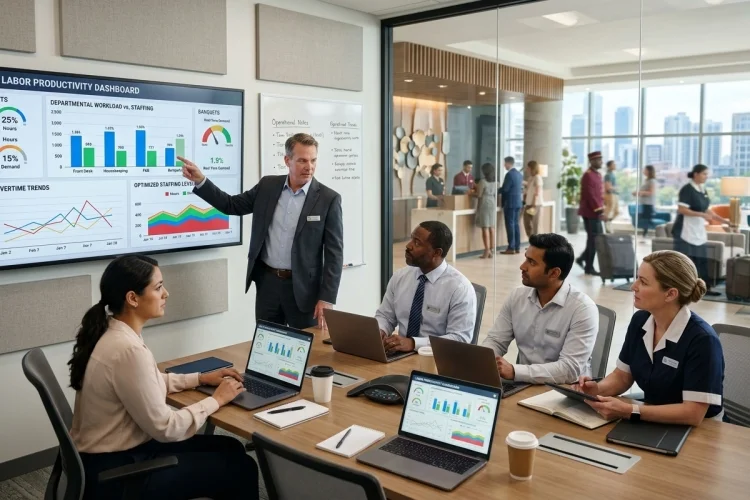
Build a Labor Productivity Dashboard
Managers should not wait until month-end P&L meetings to discover that labor productivity missed expectations.
A simple dashboard can show scheduled hours, actual hours, labor cost, occupancy, covers, overtime, and productivity ratios by department.
Compare Forecast, Schedule, and Actual Results
Three numbers are particularly useful.
First, what workload did the hotel forecast?
Second, how many hours did managers schedule?
Third, how many hours were actually worked?
Suppose housekeeping forecasts 500 cleans requiring 250 hours. Management schedules 260 hours, but employees ultimately work 300.
That variance deserves investigation.
Perhaps the rooms were unusually difficult to clean. Maybe employees waited for linen, elevators were slow, or room assignments were inefficient.
The model turns payroll variance into an operational question rather than simply telling managers to spend less next month.
CoStar’s LPAR metric similarly evaluates hotel labor expense per available room and emphasizes comparing labor growth with revenue, occupancy, property type, and local operating conditions.
Use Technology for Scheduling Precision
Workforce technology can process variables that are difficult to manage manually.
Modern tools can compare forecasted workload with available employees, identify schedule gaps, monitor overtime, and recommend shifts according to employee skills.
Oracle’s 2026 workforce scheduling tools, for example, can compare planned versus actual workload, identify coverage gaps, and recommend appropriate employees for open shifts.
Hotel-specific operational technology is also becoming more automated.
Oracle’s June 2026 OPERA Cloud updates introduced AI capabilities intended to reduce repetitive work and provide associates with real-time operational guidance.
Technology should not eliminate managerial judgment.
It should eliminate the spreadsheet-heavy adminstration that prevents managers from spending time with teams and guests.
Cross-Train Around Predictable Demand Patterns
Cross-training becomes much more valuable when it is based on data.
Suppose the hotel’s coffee outlet is busiest from 7 a.m. to 9 a.m., while banquet setup demand usually starts later.
Selected employees could potentially support breakfast operations during the morning peak before transitioning into event work.
That is very different from randomly asking employees to cover unrelated roles.
Data can reveal which demand peaks overlap and which departments have complementary workloads.
Research covering 2025 hotel labor performance found that hotels improved productivity while maintaining or even increasing headcount, with operators using techniques such as improved forecasting, cross-training, and more accurate schedules rather than relying purely on staff reductions.
Cross-training works best as capacity sharing, not hidden understaffing.
Measure Revenue per Labor Hour
Productivity should also consider what employees help produce.
Revenue per labor hour divides revenue by total hours worked. It can be calculated at the property level or within departments.
Suppose a restaurant generates $30,000 with 300 labor hours. Revenue per labor hour is $100.
After menu changes and improved scheduling, it generates $32,000 with 280 hours. The result rises to roughly $114 per labor hour.
That suggests stronger productivity.
However, managers should combine this measure with margins because high revenue does not always translate into high profit.
Banquets, restaurants, guestrooms, and spas have very different cost structures.
For that reason, profit contribution per labor hour can eventually become an even stronger metric.
Use Productivity Gains to Improve Employee Experience
Better labor management should benefit employees too.
Bad scheduling creates unpredictable shifts, unnecessary overtime, rushed work, and periods where employees have little productive work to perform.
More precise schedules can reduce those extremes.
This is especially important while hospitality continues facing workforce pressure. AHLA’s March 2026 survey found more than half of responding properties were somewhat or severely understaffed, while 65% identified labor costs as a significant financial pressure.
Better productivity therefore cannot depend on continuously asking fewer employees to do more.
Retention becomes part of the labor equation.
Hotels should monitor turnover, absenteeism, overtime concentration, employee satisfaction, and schedule stability alongside financial metrics.
A model that saves payroll but drives valuable workers away may create poor long-term efficency.
Know When More Labor Creates More Value
Advanced productivity management is not always about reducing hours.
Sometimes adding labor is the more profitable decision.
Adding another server during a busy dinner period may improve table turnover and allow the restaurant to accept more reservations.
Another front-office employee during a major arrival wave could shorten queues, improve upselling, and reduce service failures.
A productivity model should estimate the incremental value of that additional labor.
If a $150 shift creates $800 in incremental contribution while improving service, refusing to schedule it simply because payroll exceeds budget would be shortsighted.
Hotels should therefore manage labor as an investment as well as a cost.
Advanced Labor Productivity Models help full-service hotels replace static payroll thinking with demand-based workforce decisions.
By combining workload units, rolling forecasts, cross-training, scheduling technology, and profit-per-hour metrics, operators can improve productivity without sacrificing hospitality.
Start by comparing forecasted workload, scheduled hours, and actual hours for one department, then use the variance to build a smarter staffing model.