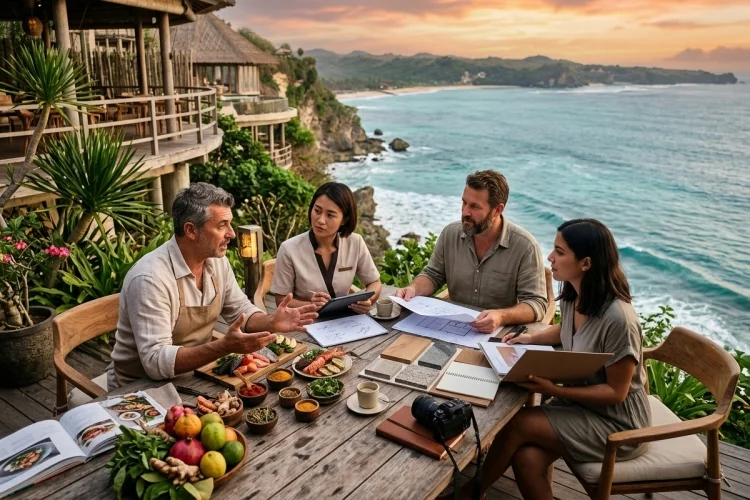
Creating a restaurant inside a destination resort comes with a strange advantage: thousands of potential customers may already be sleeping nearby.
It also creates a dangerous assumption that those guests will automatically use the restaurant. They will not if the concept feels generic, overpriced, inconvenient, or disconnected from the trip they came to experience.
Advanced Concept Development helps resort operators move past that assumption.
It combines demand analysis, local relevance, operational feasibility, sourcing, financial performance, and brand design to create restaurants that both resort guests and outside diners actively want to visit.
Position the Restaurant Within the Resort Ecosystem
A resort restaurant should have a defined job.
Some venues exist primarily to provide convenient breakfast and all-day dining. Others create premium evening experiences, support weddings and events, activate beach or pool areas, or attract customers from outside the resort.
Problems begin when a restaurant tries to do everything.
A sophisticated fine-dining room may struggle if families expect quick meals after spending all day outdoors. A casual pool restaurant may disappoint guests searching for a special anniversary dinner.
The concept brief should therefore define its primary occasions and audiences before development begins.
Hospitality Net’s recent discussion of iconic hotel F&B argues that successful venues increasingly need a strong narrative, intentional design, and destination relevance rather than simply functioning as convenient places for hotel guests to eat.
A clear role also helps avoid cannibalization between different resort outlets.
Build a Demand Map by Guest Segment
Resorts often serve several markets simultaneously.
There are overnight leisure guests, families, couples, groups, wedding attendees, conference delegates, day visitors, local residents, and sometimes members or villa owners.
Each group behaves differently.
A family may prioritize predictable pricing and fast dinner service. Couples may value atmosphere and premium cocktails. Locals may visit only if the restaurant has an identity independent of the hotel.
Current National Restaurant Association travel research indicates that travelers continue to value convenience and affordability while also seeking memorable local dining and culinary exploration.
That combination is important for resorts.
Guests may happily pay for a distinctive dinner but still want an easy breakfast or casual lunch.
Development teams should map expected demand by segment and daypart, then estimate average spend, visit frequency, party size, and seasonality.
This gives the concept a realistic commercial base rather than relying on broad occupancy numbers.
Match Service Complexity With Willingness to Pay
Luxury service is expensive.
Tableside presentations, elaborate tasting menus, highly customized dishes, sommeliers, handcrafted cocktails, and multiple service rituals can create memorable moments. They also require labor, training, equipment, and time.
The question is whether those touches produce enough customer value.
Advanced concept planning should evaluate the cost of the promised experience before the design becomes permanent.
If the restaurant requires one server for every three tables to deliver its service style, payroll assumptions need to reflect that.
Likewise, a menu based on complicated preparations may require larger kitchens, more skilled employees, additional prep space, and slower table turns.
Hospitality Net’s concept-development analysis specifically links service philosophy and experience design with staffing models, workflow, operating expenses, and guest satisfaction.
That is why feasability cannot be separated from creativity.
A service ritual deserves to stay when guests notice it, value it, and are willing to support its economics.
Use Local Sourcing as a System, Not Decoration
Local sourcing is one of the easiest ways for resort dining to connect with a destination.
The National Restaurant Association’s 2026 culinary outlook placed local sourcing among leading restaurant trends, highlighting community connections, freshness, and sustainability.
But writing a farmer’s name on the menu is not enough.
The sourcing model needs operational resilience.
Development teams should understand seasonal availability, minimum order quantities, transportation, quality variation, backup suppliers, food-safety requirements, and expected demand.
A remote island resort, for example, may want locally caught fish as a signature. If daily supply fluctuates heavily, the menu should be flexible enough to sell “today’s catch” rather than promising one species throughout the year.
This keeps the story authentic while protecting kitchen operations.
The best local sourcing feels naturally integrated into the restaurant rather than added later as marketing language.
Design Space Around Revenue and Service Flow
Restaurant design should emerge from the concept’s commercial and operating model.
A beautiful open kitchen can create theatre, but it also affects ventilation, equipment placement, noise, staffing, and guest circulation.
A beachfront terrace creates premium seating, but weather may reduce its usable capacity.
Development teams should therefore connect seat count, table mix, kitchen output, bar capacity, service routes, storage, and expected meal duration before finalizing the floor plan.
A 2025 Hospitality Net feasibility case study demonstrated how technical restrictions, accessibility requirements, infrastructure limitations, and construction costs can eventually make an attractive F&B concept commercially unviable.
That lesson applies strongly to resorts, where remote locations can make corrections even more expensive.
Good design supports the concept.
Great design supports the concept and the operatonal model behind it.
Decide Which Elements Must Be Signature
A destination restaurant needs recognizable brand codes.
These might include a particular cooking method, signature cocktail ritual, design material, music direction, uniform detail, presentation style, or hero dish.
Not everything needs to be unusual.
In fact, trying to make every element distinctive can make a concept exhausting to operate and confusing for guests.
Choose a small number of signature features and execute them exceptionally well.
An oceanfront restaurant could become known for whole-fish fire cooking, sunset aperitivo, and locally made ceramics.
Everything else can support those central ideas.
This also improves consistancy because employees understand what absolutely cannot be compromised.
The brand becomes easier to communicate in marketing, training, menu development, and guest storytelling.
Distinctiveness comes from a coherent combination of memorable details, not simply adding more details.
Test the Economics Under Different Seasons
Destination resorts often operate with significant seasonal demand.
A restaurant might be full every evening in December but struggle to cover minimum staffing during a quiet month.
The development model therefore needs several scenarios.
Calculate expected revenue under peak, shoulder, and low-demand conditions.
Then estimate what costs can flex.
Can the menu shrink slightly during quieter periods? Can one restaurant close on selected days while another outlet absorbs demand? Can employees cross-work between venues?
The financial model should also examine external customers.
If locals and visitors from nearby hotels can support demand during low occupancy, investment in a separate entrance, parking, marketing, or transportation may make commercial sense.
Cornell’s hospitality-management framework emphasizes connecting financial analysis, revenue management, F&B operations, and the wider guest journey when making hotel decisions.
Strong resort dining models use similar cross-functional thinking.
Seasonality should influence the concept before opening, not become a surprise afterward.
Measure Whether the Concept Creates Destination Value
Restaurant performance should ultimately be measured through both its own economics and its contribution to the resort.
Traditional indicators include revenue, average check, food cost, payroll, contribution margin, seat utilization, and departmental profit.
But a destination restaurant can influence other outcomes.
Does it attract non-resident guests? Does it increase social-media visibility? Do travelers mention it in reviews? Does it strengthen wedding or group sales? Does it help guests stay on property instead of dining elsewhere?
Accor’s research emphasizes the growing role of authentic and personalized dining experiences in connecting travelers with destinations.
These wider benefits should be measured where possible rather than assumed.
A restaurant that produces reasonable direct profit while materially improving the resort’s positioning may be more valuable than its standalone P&L suggests.
That is the broader logic behind destination F&B.
Advanced Concept Development for resort dining connects market demand, local identity, service complexity, physical design, and financial performance into one strategy.
The goal is not simply opening another hotel restaurant, but creating a venue guests deliberately seek out.
Define its role, test the seasonal economics, choose a few powerful signature elements, and build an operating model capable of delivering the same experiance every day.