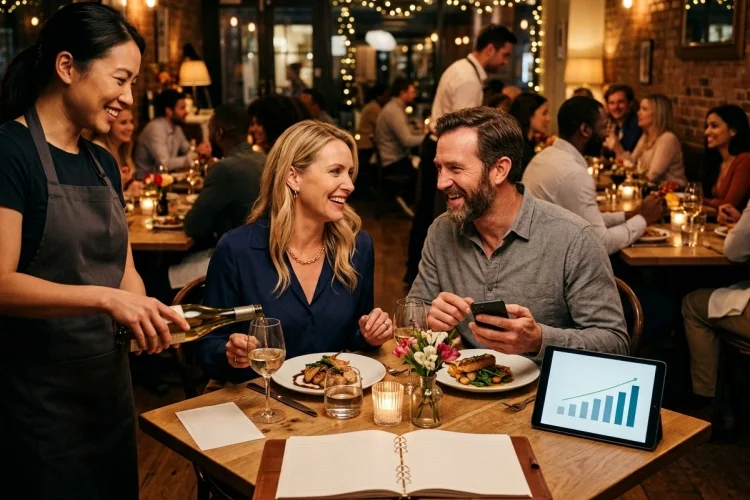
A fully booked restaurant can still have a weak customer relationship strategy. If every diner disappears back into anonymity after paying the check, the business keeps starting from zero.
Reservation platforms change that by giving operators a reliable way to connect individual visits over time.
When those bookings are combined with POS transactions, dining occasions, preferences, loyalty activity, and marketing response, restaurants can build a much clearer picture of Lifetime Guest Value.
The result is smarter retention, stronger personalization, and marketing decisions based on long-term behavior instead of one-night revenue.
Build One Guest Profile Across Multiple Visits
Customer value becomes difficult to measure when reservation data lives in one system and transaction data lives somewhere else.
The first step is creating a unified guest profile.
OpenTable explains that effective restaurant profiles can combine reservation history, visit frequency, spending habits, menu ordering patterns, dietary restrictions, seating preferences, and special occasions.
This turns several disconnected transactions into one relationship.
For example, David may have booked five times through the website, once by phone, and attended a wine dinner. If those visits are stored separately, his real value is hidden.
Connected systems should ideally reconcile them into the same profile.
Toast’s current Guest CRM similarly describes bringing orders, visits, and reservations together to help operators recognize patterns and re-engage customers.
Data reconcilation therefore becomes part of restaurant strategy rather than simply an IT task.
Calculate Value Beyond the Last Check
Restaurants frequently identify “high-value guests” by looking at one expensive visit.
That can be misleading.
A more useful approach estimates the revenue a relationship produces across time.
A simple model might be:
Guest Value = Average Check × Visits per Year × Expected Retention
Imagine Customer A spends $120 per visit, comes eight times annually, and stays active for three years.
The simplified revenue estimate is:
$120 × 8 × 3 = $2,880
Customer B spends $300 but visits only once every year for three years.
That relationship produces $900.
This calculation is intentionally basic. Restaurants can make it more sophisticated by using contribution margin instead of revenue, adding private-event spend, or estimating visits across multiple venues.
SevenRooms states that its CRM can track lifetime spend across customer profiles and locations, giving hospitality groups a broader picture than a single restaurant transaction.
That makes lifetime economics especially useful for multi-concept groups.
Add Occasion Data to the Value Model
Not every valuable guest behaves like a weekly regular.
Some customers are valuable because of the occasions they control.
A guest who reserves an anniversary dinner every year may have modest frequency. Someone who regularly organizes twelve-person business dinners could produce substantial revenue despite making only a few reservations personally.
Reservation systems provide useful ocassion signals because bookings often include party size, celebration information, preferred dining times, and special requests.
OpenTable specifically highlights dining occasion and party size as data that can make guest profiles more actionable.
Restaurants can therefore create different types of value.
A frequent-value guest returns often.
A premium-value guest consistently spends heavily.
An occasion-value guest brings large groups or celebrations.
A network-value guest may visit several restaurants within the same hospitality group.
These categories prevent the CRM from treating every loyal customer in exactly the same way.
Connect Booking Channel With Long-Term Behavior
Restaurant marketers often evaluate reservation channels by the number of bookings they generate.
That is only the first layer.
Two channels may each generate 1,000 covers but attract very different customers.
One might produce mainly first-time promotional diners who rarely return. Another may generate guests who spend slightly more and become regulars.
OpenTable’s Castellucci Hospitality Group case study describes using POS integration and reporting to track both total guest spend and booking source.
The group reported that diners booking through OpenTable tended to spend more than guests reaching the restaurants through other routes and often returned.
The strategic metric is therefore not only cost per reservation.
Restaurants can examine:
Acquisition Cost ÷ Expected Lifetime Contribution
A channel that appears more expensive upfront may be more profitable if its guests stay active longer.
That shifts marketing optimization from volume toward quality.
Detect High-Value Guests Who Are Drifting Away
Lifetime value is not guaranteed.
Even loyal customers can disappear.
A restaurant should therefore combine value with recency.
Imagine a guest has spent $4,000 during the last two years but has not visited for six months. Another has spent only $800 but visited last week and continues booking every month.
The first customer may represent high value at risk.
Modern CRM tools increasingly support this kind of segement. Toast’s Guest CRM, for example, promotes identifying high-value guests who may be at risk and sending re-engagement offers based on customer behavior.
The message does not always need to include a discount.
A favorite seasonal dish returning to the menu, an invitation to a wine dinner, early reservation access, or a personal note may be more appropriate for a premium brand.
The point is recognizing the behavioral change before the relationship disappears completely.
Make Reservation Notes Commercially Useful
Guest notes are one of the most underused forms of restaurant data.
Useful notes can capture preferences that transactions miss.
Perhaps a regular always asks for a corner booth. A business diner prefers quick lunches. Another customer orders Burgundy whenever celebrating an anniversary.
Alicart Restaurant Group has described using reservation notes and pre-shift guest information to identify VIPs, birthdays, first-time visitors, and preferences such as previous wine or red-meat orders.
These details can improve recommendations and recognition.
However, note quality matters.
“Nice guest” is vague.
“Prefers quieter rear booth; usually orders Burgundy; anniversary in October” is actionable.
Restaurants should also avoid excessive or inappropriate profiling. Notes should support hospitality and legitimate operational needs, with appropriate privacy practices.
Better notes make data feel more human rather than more intrusive.
Measure Whether Lifetime Value Is Actually Growing
A customer-value strategy needs measurable outcomes.
Operators should track whether repeat guests are returning more frequently, staying active longer, and producing stronger contribution.
OpenTable recommends KPIs including repeat visit rate, average spend per guest, visit frequency, retention, and time between visits when measuring guest-data strategies.
Restaurants can compare these metrics by segment.
Perhaps first-time guests have a 20% second-visit rate. After a targeted follow-up program, it rises to 27%.
Or maybe high-spend customers normally return every 75 days, but personalized event invitations reduce the gap to 58 days.
Those changes matter because small improvements compound across thousands of customers.
Toast’s 2026 research also suggests the economics of regulars can be disproportionately important, with a relatively small group of repeat guests accounting for a large share of order volume.
The objective is not creating a prettier dashboard.
It is increasing durable customer value profitabley.
Lifetime Guest Value gives restaurants a better way to connect reservations with long-term growth.
Unified profiles, spend history, occasion patterns, booking channels, recency, and service notes can reveal which relationships are strengthening and which are fading.
Start with clean guest profiles and a simple value formula, then measure retention over time. The strongest CRM strategy turns reservation data into better recognition, smarter marketing, and more reasons to return.