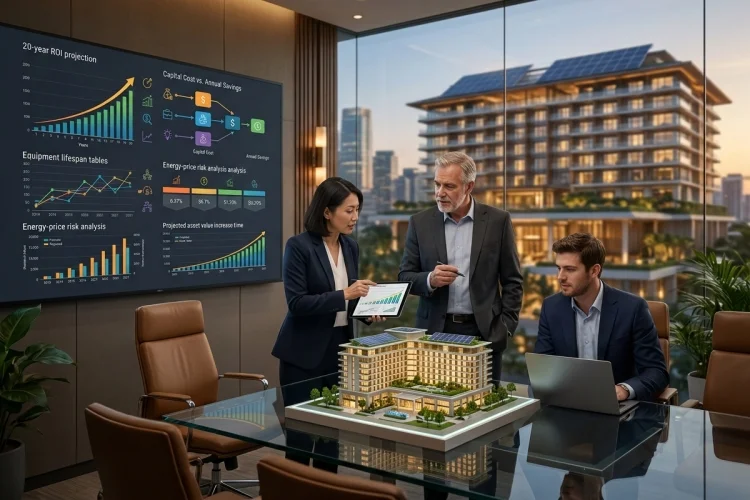
Replacing an old chiller or installing smarter guestroom controls may sound like a technical engineering decision. For hotel owners, however, it can also be an investment decision worth millions over the life of an asset.
How Hotels Model Energy Efficiency increasingly involves combining operational data with financial forecasting.
Owners compare current energy use, retrofit costs, expected savings, equipment life, and future capital requirements before deciding where to invest.
This approach is especially valuable in hospitality because hotels operate continuously and contain energy-intensive functions ranging from guestrooms and kitchens to laundries, spas, pools, and meeting facilities.
Benchmark Before Deciding What to Fix
The first rule of energy investment is simple: measure before spending.
A hotel that appears inefficient may simply have more restaurants, conference facilities, or swimming pools than its competitors. Raw utility bills do not provide enough context.
ENERGY STAR Portfolio Manager helps building owners benchmark energy and water use against previous years and, where eligible, against similar properties. Hotels are among the building categories that can receive the 1–100 ENERGY STAR score.
For eligible buildings, a score of 50 represents median performance, while 75 or above indicates top performance and may qualify the property for ENERGY STAR certification.
Benchmarking helps owners identify which assets deserve deeper investigation.
For a hotel group with fifty properties, this is especially useful because capital can be directed toward buildings with the largest improvement opportunity.
Break Energy Use Into Major Systems
Knowing the hotel’s overall electricity bill is not enough.
The next step is understanding where the energy goes.
Heating, ventilation, air conditioning, lighting, domestic hot water, kitchens, laundry, pumps, elevators, pools, and guestrooms can all create significant demand.
Advanced metering and building-management systems can help separate these loads.
Once energy use becomes visible at system level, the investment strategy becomes more precise.
For example, replacing lighting may offer relatively limited savings if the hotel’s real problem is an inefficient cooling plant.
The opposite can also happen.
A highly efficient central HVAC system may still perform badly if guestrooms are cooled aggressively while vacant.
The best model connects technology with actual guest and employee behavior.
Build a Retrofit Investment Ladder
Not every hotel needs an expensive renovation to improve energy performance.
Many owners begin with low-cost or no-cost measures before moving toward more substantial capex.
Operational scheduling, temperature set-points, lighting controls, preventive maintenance, and staff training can create savings without replacing major equipment.
HEI Hotels & Resorts developed a standardized energy set-point program covering HVAC, hot water, and food-and-beverage systems. The idea was that modest savings from individual adjustments can become meaningful when repeated across many properties.
The next level might involve lighting retrofits, variable-frequency drives, guestroom controls, or building automation.
Major investments such as chillers, boilers, heat pumps, façade upgrades, and renewable-energy systems can then be timed alongside normal replacement cycles.
This staged approach prevents perfectly usable equipment from being replaced simply to chase an efficiency target.
Use Lifecycle Cost Instead of Cheapest Capex
Hotel renovation budgets are often under pressure.
That can encourage teams to select the lowest initial-cost equipment even when a more efficient option offers better long-term economics.
NIST’s lifecycle cost methodology takes a broader approach by considering costs over an investment’s useful evaluation period. Energy, replacement, operation, maintenance, and other economic factors can therefore be compared more realistically.
Imagine Hotel A needs a new cooling system.
Option one costs $1 million. Option two costs $1.2 million but saves an extra $80,000 per year in energy and maintenance.
Looking only at capex favors option one.
But the extra $200,000 for option two could be recovered relatively quickly if those savings materialize, after which the property continues benefiting.
Real models should also discount future cash flows and test different energy-price assumptions rather than relying on a single forecast.
Test Best, Base, and Worst Cases
Energy-saving forecasts contain uncertainty.
Occupancy may change. Electricity prices may rise slower or faster than expected. Equipment performance can differ from manufacturer estimates. Guest behavior may change after renovation.
Good investment models account for that uncertainty through scenarios.
A base case might assume today’s utility rates and expected occupancy. A downside case could use lower energy-price inflation or smaller savings. An upside scenario could model stronger utility escalation.
NIST research has found that local climate, building type, size, energy rates, and analysis horizon can materially affect the cost-effectiveness of efficiency measures.
That is why copying ROI assumptions from another property can be misleading.
A heat-recovery project in one climate may make excellent financial sense, while the identical system could provide weaker economics elsewhere.
Model the actual hotel, not an imaginary average one.
Use Measurement and Verification After the Retrofit
An ROI forecast is only a forecast until real operating data confirms it.
Measurement and verification compares actual post-project performance with the expected result.
Marriott’s internal M&V framework reviews new energy-saving technologies and validates their potential returns before broader use across its portfolio.
According to the Better Buildings program, this process helps the company create more credible investment cases for property owners.
That feedback loop is valuable.
If occupancy sensors generate less savings than expected, future models can be adjusted. If a particular control strategy repeatedly outperforms expectations, it can become a stronger candidate across the portfolio.
This transforms energy management from a collection of isolated projects into organizational learning.
Link Efficiency With Planned Renovations
Some of the best energy projects are completed when the hotel is already undergoing renovation.
If guestrooms are being refurbished, that may be the right time to add occupancy controls or better lighting. When a façade reaches the end of its useful life, improved insulation or glazing can be considered alongside replacement.
This avoids paying twice for disruption, access, construction, and finishing work.
Lifecycle thinking is especially important in hospitality because guestrooms and public areas are renovated relatively frequently compared with many other building types.
USGBC identifies those repeated renovation cycles, together with pools, laundry, food and beverage, event facilities, and transient guest populations, as distinctive sustainability considerations for hospitality buildings.
Energy planning should therefore connect with the hotel’s multiyear capital expenditure schedule.
The most economical project today may simply be the project that avoids reopening the same ceiling three years from now.
Convert Energy Savings Into Asset-Level Metrics
Engineering teams often speak in kilowatt-hours.
Investors may care more about cash flow.
Energy models become more powerful when technical savings are translated into annual operating-cost reductions, ROI, net present value, and lifecycle savings.
The Better Buildings hospitality program reports that participating hospitality partners have accumulated approximately $290 million in energy and water savings since 2011.
At an individual property, recurring savings can improve operating margins year after year.
Hotel owners should also consider avoided costs.
Better equipment controls may extend equipment life. Lower cooling loads can reduce stress on mechanical systems. Predictive monitoring may reveal faults before they become major failures.
These benefits can be harder to quantify, but ignoring them can understate the real value of an upgrade.
View Efficiency as Asset Resilience
Long-term energy strategy is also about reducing exposure.
Hotels face uncertain utility prices, climate pressures, evolving efficiency standards, corporate carbon targets, and investor expectations.
A property that requires unusually high energy consumption may become more expensive to operate or renovate as those pressures grow.
USGBC currently reports that green buildings use approximately 26% less energy on average than conventional buildings, illustrating the scale of efficiency improvements that better building strategies can potentially create.
An efficient hotel is not automatically a more valuable hotel, but lower recurring consumption can make the asset easier to operate across different economic conditions.
That resilience deserves a place in investment modelling alongside simple payback.
The long-term goal is not merely lower bills. It is a more adaptable asset with fewer unnecessary operating costs.
How Hotels Model Energy Efficiency is ultimately about connecting engineering decisions with investment logic.
Benchmarking reveals the opportunity, lifecycle costing tests whether the economics work, and measurement confirms whether the savings actually arrive.
Owners should integrate efficiency upgrades into renovation cycles, test multiple financial scenarios, and translate technical savings into asset-level results. Treat energy like invested capital, and every kilowatt saved starts telling a clearer business story.