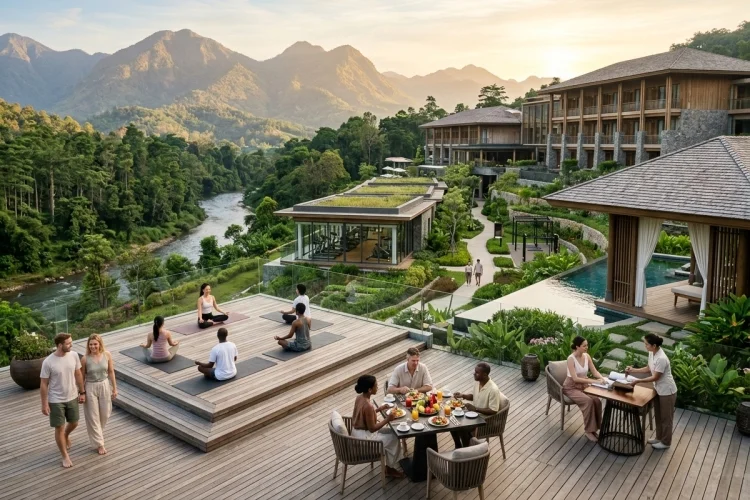
A premium resort once needed a nice spa, a few treatment rooms, and perhaps a gym to claim a credible wellness offering. That formula is changing quickly.
Today’s guests can arrive with established fitness routines, sleep trackers, nutrition goals, recovery habits, and a much deeper understanding of personal wellbeing.
For Premium Destination Hospitality Assets, this creates an opportunity to turn wellness into a defining reason to visit. The strongest strategy is not about collecting trendy treatments.
It is about connecting design, longevity, fitness, food, nature, and hospitality into an experience that also makes financial sense.
Wellness Is Becoming a Travel Motivation
Wellness increasingly influences where people go, not simply what they do after arriving.
Global Wellness Institute data puts wellness tourism expenditure at about $893.9 billion in 2024, compared with $655.1 billion in 2019 before the pandemic disruption.
The wider wellness market also reached $6.8 trillion in 2024 and is forecast to grow to roughly $9.8 trillion by 2029.
That makes wellness difficult for premium hospitality investors to dismiss as a temporary trend.
However, opportunity does not mean every resort should become a clinic.
The commercial challenge is determining which part of the wellness economy fits the property’s brand, location, guest profile, and competitive set.
Move From Facilities to Wellness Ecosystems
A gym and treatment rooms are facilities. A wellness ecosystem connects multiple touchpoints.
Sleep begins in the guestroom through bedding, acoustics, temperature, lighting, and blackout performance. Nutrition appears in restaurants and minibars. Fitness can happen in gyms, pools, gardens, hiking trails, and beaches.
Recovery can combine massage, thermal areas, hydrotherapy, stretching, and rest.
WATG’s wellness research emphasizes that hospitality wellbeing extends into sensory management, including lighting, noise, temperature, air quality, and exposure to nature.
This creates an important design principle: wellness should not begin when guests put on a spa robe.
The architecture itself can contribute to the experience.
A naturally lit breakfast space, quiet sleep enviroment, outdoor walking loop, and restorative landscape may influence wellbeing throughout the entire day.
Explore Longevity Carefully
Longevity has become one of the most visible parts of premium wellness.
Hotels and resorts increasingly discuss diagnostics, metabolic health, recovery technology, nutrition, sleep optimization, and preventative wellbeing.
CoStar reported in 2025 that fitness, wellness, and longevity are increasingly being integrated into hotel investment strategies as high-end properties respond to guests who want to maintain their health routines while traveling.
But longevity requires careful positioning.
A resort does not need dozens of expensive machines simply because they are currently fashionable.
Technology can become obsolete quickly, and medical-style services may require specialist staff, licensing, clinical governance, and stronger risk management.
Developers should start with the outcome.
If the objective is better recovery, perhaps sleep, mobility, nutrition, thermal bathing, and expert coaching produce a stronger long-term program than a room filled with equipment guests barely understand.
Balance Treatment Revenue With Space Economics
Spa and wellness spaces consume valuable resort real estate.
That makes utilization critical.
CBRE’s study of 297 U.S. hotels with operated spas found that luxury properties averaged $9,847 in spa revenue per available room in 2024, while resort hotels averaged $6,539. Across the total sample, spa revenue accounted for 3.4% of hotel revenue.
Those are useful benchmarks, but CBRE also emphasizes treatment-room utilization, revenue per square foot, profitability, and guest satisfaction when evaluating spa performance.
A ten-room spa that stays highly utilized may create better economics than a huge twenty-room facility with half the rooms empty.
Design Flexible Treatment Capacity
Some rooms can be designed for multiple services rather than one specialist treatment.
Flexible capacity helps the property respond when guest preferences change.
It can also reduce the risk of dedicating expensive floor area to a wellness trend that disappears within several years.
Create Revenue Without a Therapist in Every Room
Traditional spa economics rely heavily on labor.
That can become challenging because a treatment room generally needs a trained practitioner whenever it earns treatment revenue.
CBRE found that spa labor costs increased 3.9% in 2024 across its hotel sample, contributing to a year in which revenues increased but departmental profit declined slightly.
This explains growing interest in experiences such as saunas, hydrotherapy, thermal circuits, LED treatments, recovery equipment, and other services that may require less one-to-one labor.
The goal should not be replacing human service completely.
Premium hospitality still benefits enormously from skilled therapists and coaches.
Instead, resorts can create a balanced model where therapist-led experiences sit beside lower-labor facilities capable of serving several guests simultaneously.
That can improve capacity and commerical efficiency.
Use Wellness to Increase Length of Stay
Destination wellness can create something many resorts want: a reason to stay longer.
A guest coming primarily for the beach may book three nights. A structured five-day wellness journey can potentially create a different booking pattern.
Programs can package accommodation with fitness assessments, consultations, treatments, food plans, outdoor activities, and educational sessions.
McKinsey’s 2025 research found strong consumer interest in in-person wellness experiences, with net purchase intent of 30% for offerings including boutique fitness and wellness retreats.
It also found that many consumers are willing to travel substantial distances for wellness activities.
That supports a shift from selling individual treatments toward selling wellness journeys.
Packages can increase both commitment and revenue visibility before guests even arrive.
They can also help operations plan treatment capacity more accurately.
Turn Food Into Part of the Wellness Product
Resort wellness often becomes disconnected from food.
Guests spend the morning in yoga and recovery sessions, then encounter a restaurant menu that has little relationship with the wellness philosophy.
That is a missed opportunity.
Food can become part of the program through locally sourced ingredients, balanced menus, protein-forward options, plant-rich dishes, hydration, personalized nutrition, and educational experiences.
However, healthy food should still taste good.
Premium guests are unlikely to appreciate a sustainability or wellness message if every meal feels like a restriction.
Culinary strategy works best when it delivers pleasure first and health benefits naturally.
A destination with a strong agricultural identity can go further through farm visits, herb gardens, cooking classes, or chef-led nutrition sessions.
That turns food into both an amenity and an experience.
Make Nature the Resort’s Most Scalable Wellness Asset
Natural environments are particularly valuable because many guests can experience them without requiring individual treatment appointments.
WATG’s recent work on wellbeing-focused landscapes explores how gardens, outdoor movement, contemplative spaces, social interaction, and sensory experiences can encourage positive emotional and physical responses.
A resort can therefore design morning walking routes, meditation pavilions, barefoot gardens, forest bathing, ocean swimming, outdoor fitness, or sunset breathing sessions around its existing landscape.
Nature also differentiates destinations.
A treatment room can theoretically be replicated anywhere. A recovery experience built around a particular coastline, mountain forest, desert, or volcanic landscape cannot.
This makes the site’s natural character part of the competitive advantage.
Measure Wellness at the Asset Level
The final mistake is measuring wellness only through spa treatment revenue.
A strong program may influence ADR, occupancy, room upgrades, length of stay, food-and-beverage spending, retail, membership revenue, repeat visitation, and brand positioning.
CoStar notes that roughly 32% of average hotel revenue comes from departments outside rooms, highlighting why owners increasingly pay attention to total revenue rather than RevPAR alone.
For premium destinations, wellness can touch several of those departments simultaneously.
Management should therefore track treatment revenue and profit, but also total spend per wellness guest, package conversion, program participation, room-rate premiums, average stay length, and satisfaction.
This broader model reveals whether wellness strengthens the entire asset.
A beautiful spa is useful. A wellness proposition that attracts better customers and improves total economics is far more valuable.
Premium Destination Hospitality Assets have an opportunity to turn wellness into a genuine competitive platform rather than another amenity checklist.
Longevity, fitness, recovery, nutrition, nature, and thoughtful design can create stronger reasons to visit while opening additional revenue streams.
The priority should be focus: choose wellness experiences that fit the destination, measure their total commercial contribution, and build a program guests cannot easily find somewhere else.